Amajjii 5,2014 Amboo
Gabaasaa: Amajjii 5/2014 Godina Shawaa Lixaatti Sirni kabajaa Bokkuu
Cittuu bifa howaa ta’een ilmaan Oromoo kumootaan lakka’amaniin kabajame.
Bokkuun Ccittuu Aamboo irraa gara kibbaatti 15km fagaattee kan argamtu
Sirni kabaja Bokkuu Cittuu akka Gadaa Oromootti bakka olaanaa kan qabuu
fi Aamajjii garajalqaba Amajjii Guyyaa WBOtti aansuun Amajjii gafaa
guyyaa shani kan kabajamu yoo ta’uu kan bara kanas 5/2014 bifa baay’ee
miidhagaa ta’een kabajame jira.Sirna kabajaa Bokkuu Cittuu bara kanaa
kan asiin fulduraa irraa wanti adda godhuu Ummaanni Oromoo Godina Shawaa
Lixaa heddumminaan irraatti argamuun aadaa, seenaa, dhuudhaa,
gootummaa, Amaantaa, Afaan fi eenyummaa isaa faarsuu isaati. keessaattuu
Sabboontotni Qeerroon Yuunivarsiitii Aamboo, Yuunivarsiitii kolleejjii
RiftiVallii Damee Aamboo, Sabboontootni Magaalaa Amboo fi Gudar gamtaan
hirmachuu fi Sabboontotni Oromoo Aanotaa Aakka Aanaa Amboo, Tokkee
Kuttaayee, Xiiqur Incinni, Geedoo , Jalduu, Wancii, Walisoo fi Giincii
irra heddumminaan irraatti argamuun Oromumma fi Sabboonummaa Oromoo
sadarkaa duratti olkaasuun leellifatan.Gabasaasa Godina Shawaa Lixaa
Thursday, January 9, 2014

Wednesday, January 8, 2014
Barbaachisummaa Dhaabaa; The need for Institutions
 by Ibsaa Guutama
(Haasaa BMMW beeksisuuf tolfame jalqaba tolfame 12/14/2013) by Ibsaa Guutama
(Haasaa BMMW beeksisuuf tolfame jalqaba tolfame 12/14/2013)Oromoon durii waan halleef dhaaba qaba ture.Dhaabi tokko fooyya’u haa ta’uu guddachuufi yaa’a qaba. Akka sirna Gadaatt seerri tokko waggaa saddeet saddeetiin keessa deebi’amee ilaalama. Seerri haala Yeroo waliin deemuu akka qabu bareechanii beeku turan. Dhaabi seeraan dhaabbata. Kanaaf yeroo waliin deemuu qaba jechuu dha. Kan haala waliin hin jijjiiramne fedha ummati birmadummaaf qabu. Akeeki yk kaayyoon fedha ummataa guutuuf yaada hordofamu. |
by Ibsaa Guutama
(Originally prepared for launching event of MWMF) The Oromo had institutions for all activities and knew their importance. There was a process for an institution to be reformed or developed. According to Gadaa tradition legislation is to be reviewed every eight years. They very much understood that law had to be adjusted to conditions of the time. Institution that goes with time is indispensible for a nation. It is only peoples’ quest for freedom that does not change with time. Kaayyoo or objective principle is a guide to reach an intended goal. |
| Fakkeenyaaf akeeki demokrasii Grikii afaan hundi
leellisu kaayyoon saa bu’uuraa, bulcha ummataa dhugoomsuu dha. Sana
jechuun tokko tokkoon namaa waan isa ilaalu irrati murti kennuuf
suduudaan qooda fudhachuu ture. Biyyi guddataa yoo deemu lakkoofsi
namaas yoo baayyatu suduudaan hirmaachuun rakkisaaa waan dhufeef
iddoosotaan qooda fudhachuun murteeffame. Akeeki hundi mirga qabaachuu
garuu hin jijjiiramne. Sirna Gadaa demokraasii suduudaa fi
iddoosotaatiin qabu koloneeffataan Oromoo jalaa rukute. Hamma danda’e
buqqisee gate.
Kanaaf Oromoon dhaabota jalaa jijjigan akka deebisanii itt
ijaarraatan karaa ofii barbaaddachuu erga eegalanii turaniiru. Dhaaba
yoo jennu ijaarsa qaammi tokko hamlata karoorfate itt gaggeeffatuu
jechuu keenya. Ergamsaa fi daayi saa qaama bu’urseen murteeffama. Dhaabi
akka ilmoo namaati. Naannaa keessatt guddatu dhiibbaa guddaa itt
tolchee miira warri hin yaadnee ala horachuu danda’a. Hangammeessi
hawaasa keessa jiru, akka maal naan jedhu, saalfii, safuu, laguu,
ciigoo, sinsinnii, didhaa fi dorsisa fakkaatan bifaa geeddarsiisuun ni
mala. Kanaaf dhaabi isa caasaan namaatt mulliisan qofa utuu hin ta’in
kan barsiifataan hordofanis ta’uu ni danda’a. Dhaabi hundii fiixan hin ba’u. Dhaabi tokko abdachiisaa dha kan jedhamu, kan gaggeessan hojii kanaan dura argisiisaniin amanamummaa horatan yoo ta’e yk shakalaan waan jedhanitt kan cichan ta’uu saanii yeroon erga agarsiise duuba ta’a. Seenaan dhaabota Oromoo kurnan darbanii kan caqaseef barumsa guddaa ta’a. Kaan amba kana erga mirqaansanii harka rukuchiisanii booda mirga agarsiisani bitaa lufanii. Hanqinni saanii maal ture? Kan waa tolchuuf ka’an hundi sana qorachuun kufaatii irra oolchuu danda’a. Dhaabi hanqina hawaasa tokko keessatt argamu guutuuf ijaarama. Namooti dhaabicha hogganan hanqina jiru hubachuu qofa utuu hin ta’in sana guutuuf kutatoo fi akeeka saaniif dudhama kan qaban ta’uutu irra eegama. Akkasumas dhaaba saanii haleellaa dhokataa fi mullataa hamajaajiin aggaamamu irra eeguuf dammaqoo ta’uu qabuu. Dhaadannoon dudhama hin mirkaneessu kanaaf itt deemanii hojii irra oolchuu dha. Waggaa dhibbaa oliif Oromoon akka koloneeffataan barbaadett malee akka ofii barbaadutt bulanii hin beekanii. Kanaaf dhaabi maqaa saaniin ijaaramu kan madaalamu ummatichi mirga hiree saa sabummaa ofiin murteeffachu gara dandeessisutt tattaafii agarsiisaniinii. Ummati Oromoo kanaan dura qabsoo baldhaa hunda hammataa gaggeeffatee hedduu itt wareegee milkii guddaas galmeeffate. Milkiin sun sabboonota xiiqiin Oromummaa kaakaaseen argame. Wayyabi saanii ijoollee qotee bulati. Onneen kakaasee dafqa fi dhiigaa saanii wareeguufi dhihaatan malee barumsa olaanaa fi kan addaa qabaataniif miti. Garuu hoggansi dhiibbaa adda addaa irra of eeguu fi yaada haromfachuu dadhabuun dhaabi malbulcha hedduu abdatame laasha’ee jira. Beekaa haa ta’uu wallaalaa wanti halle kan dalga itt gale fakkaata. Oromoon ala kana jiran waaggaa hedduuuf laasha’aama kanatt dhagaa guuruu fi deggeruutt diina gargaaraa fi walis mammadeessaa bahani. Alana gara itt qaban waldhaalluun akka hireen saanii godhe hata’an jedhanii kan itt dhiisan fakkaata. Hanqinni Oromiyaan qabu hedduu waan ta’eef garee gareen ogummaan waan wal hin giphasifnett bobba’aa jori. ABOn ammaaf malee, egereen saa hin yaaddessuu. Keessaan haa ta’uu alaan diiganii balleessuu irra ol ta’eera. Amma Ilmaan Oromoo jalaa ka’iin dammaqaa waan dhufaniif, kan bade hunda deebisanii ijaaruuf mala dhahaa jiru. Kan hojjechuu bobba’uu fedhaniif, baldhanni dirree hamma hin qabu. Dhihenyuma kana sochiin “Afaan” jedhu hagam akka milkaawe argaa jirra. Kanaaf fula fuulan qabaa jabeeffachuu dha. Sana malee utuma malbulcha qofaa irratt ija babaasanii diinagdee fi hawasomaan gaafa biyyi argamu qophii dhabuun dhaqqabuu danda’a. Hobbaati sochootii amma tolfamaa jiranii, bulee kan qindeessu dhaabi malbulcha barbachisaa dha. Garuu al tokkoon hin baabsinees dhaaba malbulchaas ta’uu hin dandeenyu. Dhaabota ijaaramaa jiran keessaa Bu’uursa Media Madda Walaabu kan jedhamu afaan Oromoon Amajjii tokkoo 2014 irraa ka’ee dhaamsa raadiyoo biyyatt facaasuuf karoorfatee socho’utt jira. Barruunqabii (documents) akka heera, seeraa fi dambiilee, ergamsaa fi daayaa, yoo ilaallu karaa isaan jalqaban amansiisaa ta’a. Hojiin fulduratt ilaallaa. Leellisoo gola kamiiyyuu akka hin taane fi dhaaba Oromoo kamuu deggeruu malee akka gufuu itt hin taane barruunqaboti kun ni agarsiisu. Kanaaf Barlabsi Gubirmans hamma isaan karaa jedhan irra deemanitt waliin ijaajja. Gocha saanii keessattis qooda fudhata. Sochiin “ganda, amantee, gosa kkf” “Dura Nuti Oromoo dha” jechuun dhaadannoo angafoti waggaa shantama dura ittiin ummata dammaqsaa turan haaromsee kan labses waan akeekkatettshaffisaan akka milkaawu hawwinaafi. Kan akeeka tokkoo qaban gamtaan bobba’uun anjaa akka qabu qayyabachaa walii tumsuuf ammumaa karaa mijjeessaa deemuun gamnummaa dha. Hunduu akeeka taliilaa, bilchaataa fi garaa qulqulluun hanga bobba’anitt wanti hin milkoofneef hin jiratu. Oromoo ogeeyyiin yoo waliinis garee gareenis bobba’an wanti tulchuu danda’an daanga hin qabu. Alana waan ittiin walbarsiisan fi wal dammaqsan tolchuuf kan tattaafataa jiran eebbifamoo dha. Sun dandeett Oromoo olkaasanii ummaticha aangessuuf yoo ta’e gammachuu hundaati. Hanqina jiru guutee dhaabota hawaasomaa kan gitaa fi ilaalchaan hin baabsine diriirsuu,dandessisa. Qoodi miseensotaa gargaarsa, yaadaa, horii, humnaa, dandeettii, beekumsaa fi hamilee gumaachuu dha. Namoota biyyaaf yaadan sanaaf hiriirsuunis qooda saanii ta’a. Oromoon holola halagaa locaa ta’e qofa dhaggeeffachuu erga nuffee turee jira. Kanaf dhaqabuufii kan murteeffatan shaffisuun barbaachisaa dha. “Qaqqabatan dhirsaa namatt fida” jedhama. Oromoon gaanfa Afrika keessa ummata wayyaba. Dhaabota bu’a malee qofa utuu hin ta’in kan bu’aaf ijaaramanis gabaa riphaa guddaa qabu. Guddina saanii bahee mullachuuf hanqina dhaabota diinagdee, hawaasomaa fi laafina dhaabota malbulchaatu jira. Dhaabi waan jedhu shaffisaa fi mudaa malee hojiirra oolchu miseensaa fi deggertootaa boonaa fi gammachuu horaafi. Dhaabicha keessatt qooda kan fudhatan muuxxannoo duubaaf tolu argachuu danda’u. Dhaabi bakka itt waa baratan, dirree adda addaaf bakka hogganoota keessaa maddisiifatanii fi aadaa saanii itt misomfatan ta’uu danda’a. Yero itt namooti afuura walii dhabanii mediyaa hamajaajiin afanfajjeeffamaa jiran kana, media ittiin dhaqabnu ijaarra kan jedhan as bahuun hammaam garaa lammii haa ciibsuu? Kana Caalaa kennaa Waggaa haaraa malliitu jira? Oromoo ala jiraniif ummata saanii dhaqabuu boonsaa dha. Ummmata waa’ee fayyaa saa, jiru saa fi oolmaa saa dammaqsuun waan yeroon gaafatu. Si’ana ilaalcha addunya gara barbaadanitt kan masakan kan mediyaa qabanii. Hundu fedha sabaa fi daldala ofii duratt ittiin dhiibu. Sochooti si’ana mumuldhataa jiran fedha ummata Oromoo fi cunqurfamootaa ifa baasuu qabu. Dhaamsi saani hunduu akka dhagahaa jirrutt Oromummaa irratt hundaawaa. Raadiyoo walabi maqaa Oromoon Oromiyyaa dhaqabu SBO qofa ture. Inni sagantaa bilisummaa Oromoo utubuuf dhaabbate. Dhaaboti amma ijaaramaa jiran kan xiyyeeffatan hawasomaa fi diinagdee irratt yoo ta’e bu’aa wayyaa qabaatu. Sagantaa dhaaba malbulchaa kamiifuu hin baabsinee fi dhaaba malbulchaa ta’uufis hin dorgomnee yoo ta’an dhaddhaqii sochooti isaan dura seenan irra of baraaru. Waa’ee malbulcha barsiisuu utuu hin ta’in waa’een dhaaba malbulchaa sochoota si’ana jiran irra addatt ilaalamuu qaba. “Afaan fi BMMW sana ifa baasuu saaniif galata qabu. Hunduu jalqabamanii akka duubatt hin deebine duubaa haa dhiibnu. Hanga ummati Oromoo mirga hiree ofii ofiin murteeffachuu haala mijjeessanitt, hundi saanii dhabota keenya. Garagarummaa bubbucuu qaban afarsuu caalaa wal qayyabachuuf tattaafachuun mala adda addaa nuuf burqisisu jennee abdanna. BMMWn keessa deebinee baga ooffalte jennaa. Ayyaana Oromummaa yoomu haa jabeessinuu. Qabsoon it fufa! Ulfinaa fi surraan gootota kufaniif; walabummaa, walqixxummaa fi bilisummaan kan hafaniif; nagaa fi araarri Ayyaana abboolii fi ayyoliif haa tahu! Ibsaa Guutama Sadaasa 2013 |
For instance the objective of Greek democracy which
most tongues praise was to assure adherence to people’s government. That
means each citizen of a city had to participate directly in the
decision making for all things of their concern. When territories start
to expand and population increased it became difficult to practice
direct democracy and so representative democracy was introduced. But the
basic objective of empowering each citizen to have the right to vote
was not altered. The colonizer destroyed Gadaa system, which had both
direct and representative democracy.
It has been long since Oromo started to look for their own ways to
reconstitute their destroyed institutions. By institution we mean an
organization one founds to carry out a planned task. Mission and vision
of such organization is determined by one that founded it. Institutions
are like human child. The environment of its upbringing can influence
and change the character intended for it. Norms in society like care for
public opinion, shyness, moral considerations or safuu, abstinence,
rejections, fads, challenges and threats can influence it change from
the intended purpose. An institution is not only formal but also can be
informal as well. Not all institution reaches their goal. An institution is said to be dependable if those running it have proved themselves in their previous undertakings or after they prove themselves in practice. The history of Oromo organizations of the past ten years could be a lesson for those who had followed them. Some showed left and turned right after arousing the people to frantic applauds. What were their shortcomings? Investigating that could save those who are planning for new projects from similar debacle. Institutions are built to overcome shortcomings in society. People who take that mission should not only know the shortcomings but also must be determined and have commitment for their undertakings. They must also be vigilant to protect their institution from hidden and open enemy attack. Slogans do not prove commitment until one goes ahead and implement it. The Oromo had never lived for over hundred years by their own will but by the will of the colonizer. Therefore an institution founded on their name will be weighed against how much it contributes towards the realization of the nation’s right to national self determination. The Oromoo people had a wide ranging struggle in which several were sacrificed and great gains were registered. Those gains were achieved by sacrifice of nationals whom unbearable humiliation on Oromummaa agitated them to rise. Majority were peasants‘sons and daughters. Except for inborn bravery they had no higher education or specialization but their sweat and blood to offer. But incapacity of the leadership to protect the organization from different pressures and in changing their ways of thinking paralyzed the political organization the nation counted on. Whether it is from ignorance or design they are unable to take it out of the doldrums. The Oromo in foreign lands had wounded each other for long by either keeping on throwing rocks on the paralyzed or supporting it. This time when they are unable to help it they seem to have left it to its fate. Since short comings in Oromiyaa are tremendous, it seems they have chosen to professionally handle in teams those things that cannot create controversy among actors. But except for the moment the future of OLF, the vanguard of Oromo struggle is not a point of worry for it has gone beyond being destroyed internally or externally. Now the upcoming Oromo generation is gaining consciousness that they have started to device how to reinstitute all that had been destroyed. For those who want to work, the field is boundless. Recently we have seen how the movement called “Afaan” had succeeded in its mission. For this reason it is good to handle strongly in all fronts. Otherwise there could come a time when one is under prepared in having economic and socially institution by only focusing now on political organizations. The need for political organization in coordinating what present institutions outcomes is obvious. But we cannot be a non partisan and a political organization at the same time. Among institutions being founded at present Madda Walaabu Media Foundation (MWMF) is moving to make life radio broadcast to Oromiya and the Horn in Afaan Oromo and English from January 1, 2014. Judging from their documents on bylaws, articles of incorporation, rules and regulations, and mission and vision, the way they have started is convincing. What remains will be observing them in practice. For that all have to give them benefit of the doubt. The documents assure supporters that they favor no particular organization or would they create any obstacle to Oromo organizations other than supporting them. For this reason Gubirmans Publishing stands with them as long as they stick to those principles. It will participate to its ability in their activities. We also wish success for the movement that has according to the writer’s understanding announced “We are Oromo first” before “region, religion, tribe etc.” renewing the slogan their elders used to campaign for Oromo consciousness half a century ago. It would be wise to understand that it is advantageous to move in cooperation with those having similar objectives and start to create conducive atmosphere to that end. As long as all move with clear, matured objective in good faith there is no reason for not being successful. If Oromo professionals move all together or in teams what they could achieve have no limits. Those, who this time are preparing something, that help to teach and contribute towards each other’s consciousness are the blessed. If that is to develop Oromo capabilities and empowering the nation it would earn happiness for all. It could also enable to overcome existing shortcomings by creating social and economic institutions that do not make class and outlook distinctions. The Oromo are long fed up of nauseating alien propaganda. Therefore for those who had announced to reach them it is essential to hurry up. It is said “a slow lover gives chance for the husband’s arrival.” The Oromo are majority in the Horn of Africa. They have potential markets not only for nonprofit institutions but also for those working for profit. For this size to be noticed they lack strong economic and social organizations and weakness in political ones. An institution that delivers fast and effectively what it promised is not only a pride for supporters and members but also gives all confidence to talk about it. The role of members are not only contributing ideas, money, labor, capabilities, and knowhow and raising morale but also rallying support from possible sympathizers. An institution could be ground for participants to gain experience and a place to train futures leaders for several fields and for developing ones culture. What greater happiness could be there for a nation than hearing the gift of independent media for the New Year, at a time like this, when people had lost contact of each other and alien propaganda is confusing them? What best wish message could be there greater than this short of independence? Reaching their people will be of great pride for Oromo in Diaspora. To make people conscious of their health, their activities, and their living is what the time demands. These days those who can guide public opinion as they like are those who own media. They use it to advance their national and corporate interests. The movements we are seeing nowadays have to advance the interest of Oromo and other downtrodden. We are hearing that all their messages are based on Oromummaa. The only independent radio that reaches Oromiyaa was the voice of Oromo liberation (SBO). Its purpose is to advance the political program of Oromo liberation. Institutions being built these days could have a greater benefit if they focus on the economy and social affairs. Neutrality to existing intra Oromo political division could save from the cog mires their predecessors fell into. Not giving political education but the matter of political organization must be separated from present movements. MWMF deserves special thanks for having clear stand on this issue. Let all put pressure on all of them from behind to keep them from faltering. As long as they contribute for the realization of Oromo right to national self determination, they all remain our common institutions. We hope they will work towards better understanding and find for us new techniques rather than allowing minuscule differences to keep them apart. We would like to once again congratulate MWMF for its declared success. Let us keep up the spirit of Oromummaa ever alive. Qabsoon itt fufa! Honor and glory for the fallen heroines and heroes; liberty equality and freedom for the living and nagaa and araaraa for the Ayyaanaa of our fore parents! Ibsaa Guutama December 2013 |
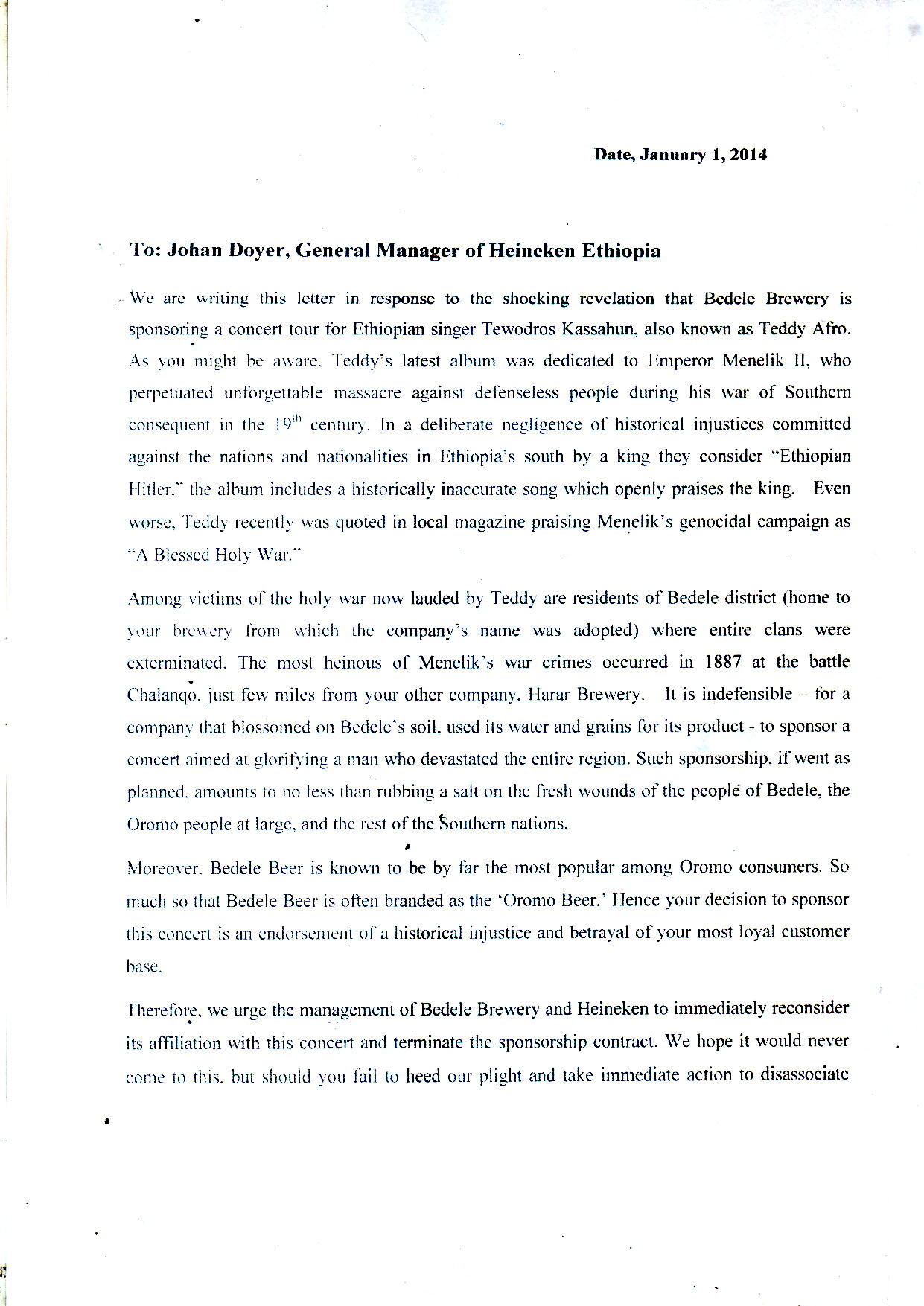
Koreen bakka bu’oota dhaabbilee barnoota ol’aanoo Bulchiinsa Mootummaa Naannoo Oromiyaatii fi Obbo Johan Doyer,General Manager of Heineken Ethiopiaf xalayaa barreesse.
Guyyaa Mudde 30,bara 2013. barreefame
Bulchiinsa Mootummaa Naannoo Oromiyaatiif/BMNOf/.
-Iyyannoon kun ariifachiisaa ta’uu irra darbee qaama dhimmi isaa ilaallatu hundaan furmaata yeroo hin kennine kan barbaadu ta’uu dursnee jabinaan hubachiisuu barbaanna.
Dhimmi harma muraa ayyolee Oromoo fi harka muraa abbootii Oromoo namticha mootii ofiin jedhu Miniliik 2ffaan gochi gara jabinaa Oromoota irratti gaggeeffamaa ture seenaa yeroo dhiyoo fi Oromoota biratti yoomuu kan hin dagatamne ta’uu isaa duubatti deebinee seenaa wal barsiisuu otoo hin ta’iin wal yaadachiisuun qofti ga’aa fakkaata. Kun ammo kan akka Oromoottiis ta’ee akka namaatti boqonnaa nama hin kennine ta’uu isaa namni akka namaatti yaadu hubachuu dhiba jennee hin amannu.
Egaa dabni yeroo dheeraaf gaggeeffamaa ture kun akkanaan otoo jiru Oromoota biratti waan dagatame fi dhokate fakkeessuun namoonni hawwii bulchiinsa namticha kanaa qabanii figochaa isaa kanaaf deeggarsa fi gammachuu qaban har’a kabaja ykn faarfannaa waggaa dhibbaffaa mootii Miniliik jechuun Oromoo fi Oromiyaa irra naanna’uun maqaa konsertiin ispoonsarummaa waarshaa biiraa baddalleen wal ta’uun faarfachuuf qophii xumuranii akka jiran kan eenyu jalaa iyyuu hin dhokannee fi ifatti hubatamaa jiru dha. Kun immoo uummata miidhame isaa kana seenaaf jedhee qabatee obsaan taa’e kana madaa isaa yeroo irratti gammachuun faarfatan callisee obsaan dhaggeeffata jedhanii yaaduun ykn eeguun gara laafina irra tufii ta’uu hunda keenya jalaa waan dhokatu hin fakkaatu. Tarii gochaan maal dhibdiin ykn maaltu dhufaan gaggeeffamuuf jiru kun mootummaa ykn sirni biyya bulchaa jiru addattu mootummaan naannoo Oromiyaa akkamiin irraa callisee ilaala? kan jedhu gaaffii uummata Oromoo ta’uus, gochaan kun uummata Oromoo saboota kaan waliin kabajaa fi obsaan jiraachaa jiru seenaa badaa kana myeroo irratti faarfamu of irraa ittisuun waan dirquuf kallattii hin barbaachisne qabachuun dirqama ta’uun hundi keenya hubachuu feesisa.
Kanaaf,qaamni dhimmi isaa ilaallatu hundi addatti mootummaan naannoo Oromiyaa gaaffii keenya kaanf deebii kennuu qofaa otoo hin ta’iin, akka abbaa dhimmaattiis hal dureen fuula dura dhaabbachuun gochaan kun Oromiyaa irratti gonkumaa akka hin dandahamiin jabinaan ittisuun akka irraa eeggamu hubachiifna.Gaaffiin karaa seera qabeessaan eegale kun gama qaama dhimmi ilaallatu hundaatti marsaa marsaan haga bulchiinsa aanaatti itti fufuun deebii akka argatu qabsoon ykn gaaffiin keenya akka itti fufuus gamanumaa hubachiisuu irra dabree gaaffiin karaa seeraa fi mirgaan gaafatamaa jiru kun atattamaan furmaata argatee warri gochaa kanaaf tirtiraniis addatti weellisaa Teedii Afroo fi waarshaa biiraa Baddallee gochaa isaanii kana irraa dhaabbatanii seera fuula duratti yoo hin dhiyaannee fi gochaa isaanii tuffiin itti fufanii argaman Oromoon kamuu kanaa ol obsa kan hin qabne ta’uu hubatamee miidhama ga’u kamiifuu gaafatamaan sirna biyya bulchaa jiru addatti mootummaan bulchiinsa naannoo Oromiyaa,Waarshaa biiraa Baddallee fi weellisaa Teedii Afroo akkasumaas kanneen duubaan deeggarsa gochaa jiran hundaa akka ta’e jabeessinee hubachiifna.
Maqaa fi Mallattoo………..
Mudde,bara 2013.
Koree bakka bu’oota dhaabbilee barnoota ol’aanoo
Bulchiinsa naannoo Oromiyaaf:- scan0001.pdf
Heineken Ethiopiaf:-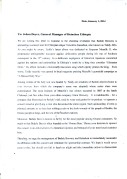
Bulchiinsa Mootummaa Naannoo Oromiyaatiif/BMNOf/.
Finfinnee
Dhimmi Isaa:-Faarfannaa waggaa dhibbaffaa Miniliik Oromoo fi Oromiyaa irratti gaggeeffamuuf deemu ittisuuf.
- Nuti kanneen maqaa fi mallatoon keenya armaan gaditti eerame dhimma atattamaa kana bakkaan ga’uuf bakka buutota dhaabbilee barnoota ol’aanoo irraa koree ariifachiisaa ta’uun muudamnee jirra.-Iyyannoon kun ariifachiisaa ta’uu irra darbee qaama dhimmi isaa ilaallatu hundaan furmaata yeroo hin kennine kan barbaadu ta’uu dursnee jabinaan hubachiisuu barbaanna.
Dhimmi harma muraa ayyolee Oromoo fi harka muraa abbootii Oromoo namticha mootii ofiin jedhu Miniliik 2ffaan gochi gara jabinaa Oromoota irratti gaggeeffamaa ture seenaa yeroo dhiyoo fi Oromoota biratti yoomuu kan hin dagatamne ta’uu isaa duubatti deebinee seenaa wal barsiisuu otoo hin ta’iin wal yaadachiisuun qofti ga’aa fakkaata. Kun ammo kan akka Oromoottiis ta’ee akka namaatti boqonnaa nama hin kennine ta’uu isaa namni akka namaatti yaadu hubachuu dhiba jennee hin amannu.
Egaa dabni yeroo dheeraaf gaggeeffamaa ture kun akkanaan otoo jiru Oromoota biratti waan dagatame fi dhokate fakkeessuun namoonni hawwii bulchiinsa namticha kanaa qabanii figochaa isaa kanaaf deeggarsa fi gammachuu qaban har’a kabaja ykn faarfannaa waggaa dhibbaffaa mootii Miniliik jechuun Oromoo fi Oromiyaa irra naanna’uun maqaa konsertiin ispoonsarummaa waarshaa biiraa baddalleen wal ta’uun faarfachuuf qophii xumuranii akka jiran kan eenyu jalaa iyyuu hin dhokannee fi ifatti hubatamaa jiru dha. Kun immoo uummata miidhame isaa kana seenaaf jedhee qabatee obsaan taa’e kana madaa isaa yeroo irratti gammachuun faarfatan callisee obsaan dhaggeeffata jedhanii yaaduun ykn eeguun gara laafina irra tufii ta’uu hunda keenya jalaa waan dhokatu hin fakkaatu. Tarii gochaan maal dhibdiin ykn maaltu dhufaan gaggeeffamuuf jiru kun mootummaa ykn sirni biyya bulchaa jiru addattu mootummaan naannoo Oromiyaa akkamiin irraa callisee ilaala? kan jedhu gaaffii uummata Oromoo ta’uus, gochaan kun uummata Oromoo saboota kaan waliin kabajaa fi obsaan jiraachaa jiru seenaa badaa kana myeroo irratti faarfamu of irraa ittisuun waan dirquuf kallattii hin barbaachisne qabachuun dirqama ta’uun hundi keenya hubachuu feesisa.
Kanaaf,qaamni dhimmi isaa ilaallatu hundi addatti mootummaan naannoo Oromiyaa gaaffii keenya kaanf deebii kennuu qofaa otoo hin ta’iin, akka abbaa dhimmaattiis hal dureen fuula dura dhaabbachuun gochaan kun Oromiyaa irratti gonkumaa akka hin dandahamiin jabinaan ittisuun akka irraa eeggamu hubachiifna.Gaaffiin karaa seera qabeessaan eegale kun gama qaama dhimmi ilaallatu hundaatti marsaa marsaan haga bulchiinsa aanaatti itti fufuun deebii akka argatu qabsoon ykn gaaffiin keenya akka itti fufuus gamanumaa hubachiisuu irra dabree gaaffiin karaa seeraa fi mirgaan gaafatamaa jiru kun atattamaan furmaata argatee warri gochaa kanaaf tirtiraniis addatti weellisaa Teedii Afroo fi waarshaa biiraa Baddallee gochaa isaanii kana irraa dhaabbatanii seera fuula duratti yoo hin dhiyaannee fi gochaa isaanii tuffiin itti fufanii argaman Oromoon kamuu kanaa ol obsa kan hin qabne ta’uu hubatamee miidhama ga’u kamiifuu gaafatamaan sirna biyya bulchaa jiru addatti mootummaan bulchiinsa naannoo Oromiyaa,Waarshaa biiraa Baddallee fi weellisaa Teedii Afroo akkasumaas kanneen duubaan deeggarsa gochaa jiran hundaa akka ta’e jabeessinee hubachiifna.
Maqaa fi Mallattoo………..
Mudde,bara 2013.
Koree bakka bu’oota dhaabbilee barnoota ol’aanoo
Bulchiinsa naannoo Oromiyaaf:- scan0001.pdf
Heineken Ethiopiaf:-
Tuesday, January 7, 2014
Ethiopia’s Court Sentences Oromo Political Prisoners
 January 7, 2014 (CNN iReport)
— Ethiopian Federal Court gave a prison sentence to an Oromo
nationalist and political prisoner from three to twelve years in
prison.The defendants were arrested in 2010 and were accused of being
members or sympathizers of the Oromo Liberation Front, or OLF, which the
government considers to be a terrorist group.
January 7, 2014 (CNN iReport)
— Ethiopian Federal Court gave a prison sentence to an Oromo
nationalist and political prisoner from three to twelve years in
prison.The defendants were arrested in 2010 and were accused of being
members or sympathizers of the Oromo Liberation Front, or OLF, which the
government considers to be a terrorist group.Most of the prisoners are members of Oromo People`s Congress(OPC) and Oromo Federalist Democratic Movement(OFDM).
1. Teshale Bekeshi……..
2. Tirfesa Megersa……..Oromo People`s Congress
3. Mulatu Abdissa……….
4. Wegayehu Dejene…..
5. Bulcha Sori Guyu…….Oromo People`s Congress
6. Gutu Mulisa……………Oromo People`s Congress
7. Asfaw Angaso……….Oromo People`s Congress
8. Mezgebu Debela…..
9. Itana Senbeto……..Oromo Federalist Democratic Movement
10. Taddese Gelalcha….Oromo People`s Congress
11. Waqgari lechisa…….Oromo People`s Congress
12. Gurmesa Fufa………Oromo People`s Congress and others oromo nationalist sentences from 3 to 12 years.
Source: CNN
Sunday, January 5, 2014
South Sudan general killed in ambus

Sudan’s arid north is mainly home to Arabic-speaking Muslims. But in South Sudan there is no dominant culture. The Dinkas and the Nuers are the largest of more than 200 ethnic groups, each with its own languages and traditional beliefs, alongside Christianity and Islam.
January 5, 2014 (BBC News) — A South Sudanese army general has been killed in fighting outside the rebel-held town of Bor.
A BBC correspondent with government troops said a convoy advancing on Bor came under heavy fire in an ambush.
The fighting is continuing as the warring parties meet in Ethiopia to try to agree a ceasefire. Substantive talks appear to have been delayed once again.
The conflict pits supporters of President Salva Kiir against rebels led by his sacked deputy Riek Machar.
It began on 15 December after the president accused Mr Machar of attempting a coup – which he denies.
At least 1,000 people have been killed and nearly 200,000 displaced in the conflict, which has taken on ethnic undertones. Mr Kiir is from the Dinka community and Mr Machar from the Nuer group.
Fighting rages
BBC News, outside Bor
The rebels are not just a ragtag group of civilians with guns – although there is an element of that.
It’s actually a whole division of the South Sudan army that has joined the rebel side. So you’ve got army fighting against army. They’re both very well armed. The government has been trying for a few days to retake Bor. It still hasn’t managed to get through. We’ve seen bodies on the road and two burnt-out tanks. We’ve seen very heavy fighting between two trained armies.
The rebels are not just a ragtag group of civilians with guns – although there is an element of that.
It’s actually a whole division of the South Sudan army that has joined the rebel side. So you’ve got army fighting against army. They’re both very well armed. The government has been trying for a few days to retake Bor. It still hasn’t managed to get through. We’ve seen bodies on the road and two burnt-out tanks. We’ve seen very heavy fighting between two trained armies.
The BBC’s Alastair Leithead was travelling with government troops from the capital, Juba, on Sunday when the convoy came under attack about 25km (15 miles) from Bor.
The commanding general – who has not been named – was killed in the ambush.
The government has been sending reinforcements to try to retake Bor in recent days, bringing the total number of army troops involved to some 2,000.
A whole division of the South Sudanese army has joined the rebel side, so the fighting in Bor in effect involves two trained armies, our correspondent adds.
He says he saw evidence of the intensity of the fighting, with burnt-out tanks by the side of the road.
Fighting is also continuing in other areas. Army spokesman Philip Aguer said there had been clashes in the oil-producing states of Unity and Upper Nile in the north.
Up until Friday, the talks in the Ethiopian capital, Addis Ababa, were conducted by mediators. Now, teams representing the opposing factions are expected to negotiate face-to-face.
A preliminary meeting was held late on Saturday. Key issues are establishing a ceasefire, and the rebels’ demand for the release of what they see as political prisoners.
But substantive talks failed to get under way on Sunday, delayed by disagreements over the agenda and – an official was quoted as saying – by “protocol issues”.
It seems each side is trying to gain as much leverage on the battlefield before they even consider a ceasefire, says the BBC’s Africa editor Richard Hamilton.
International mediators may be losing patience with South Sudan’s leaders whose delays are costing hundreds of lives, he says.
‘Arm twisting’
It is now hoped talks will begin on Monday.
South Sudan spokesman Michael Makuei said the government would resist international pressure to free supporters of Mr Machar arrested in Juba at the start of the conflict.
He said releasing “those who attempted to overthrow a democratically elected government” would set a “bad precedent”.
“Are we not risking the governments of Africa and the rest of the world to such attempts? We should not be arm-twisted because we are a new nation.”
Meanwhile the first aid flight to South Sudan funded by the UK government has arrived in the country. The aircraft, carrying emergency aid and sanitation supplies, landed in Juba, on Sunday.
South Sudan is the world’s newest state. It was formed in 2011, gaining independence from Sudan after decades of conflict.
The latest trouble has its roots in tensions that go back long before 2011.
 Fighting erupted in the South Sudan capital, Juba, in mid-December. It followed a political power struggle between President Salva Kiir and his ex-deputy Riek Machar. The squabble has taken on an ethnic dimension as politicians’ political bases are often ethnic.
Source: BBC News
Baqattoonni Oromo Magaalaa Cairo-Egypt keessa jiraatan ayyaana WBO fi Amajjii 2014 bara haaraa haala ow’aadhaan kabajatan.
Ayyaana WBO fi Baraa Haarawa Ilaalchisee, CTBOBM Milkiin Ayyaaneffatte.

 Baqattoonni Oromo Magaalaa Cairo-Egypt keessa jiraatan ayyaana WBO fi Amajjii 2014 bara haaraa haala ow’aadhaan kabajatan. Galii ayyaanicharraa argamus %50 WBO gumaachuufis murteeffatanii jiru. Haala kanaan ayyaana waggaa haaraa bara 2014 fi yaadannoo qabsaawota Oromoo bilisummaa oromootiif lubbii isaanii wareeganii fi ammas wareegurra jiran haala nama gammachiisuun yaadanii waan dandeettii isaaniitiin qabsoo Oromootiifis gumaachuu fi tumsa barbaachisu godhuuf qophii ta’u isaaniillee insatanii jiru.
Barri 2014 bara gammachuu, kan milkii fi kan bilisummaa akka ta’us Oromoo ta hundaaf hawwii qaban ibsaniiru.
Barri 2014 bara tokkummaa fi bara hawwiin ilmoo Oromoo hundaa gutamu waaqni nuuf haa taasisu.
Koree Waldaya Baqattoota Oromoo Biyya Masrii
Amajjii 01 bara 2014
Gabaasa guutuuf:- http://www.oromiapress.com/
Saturday, January 4, 2014
Ethiopia: Dark side of Oromo expansions and Menelik conquests
By Abera Tola
January 4, 2014
Through out history; people have migrated and expanded seeking greener pastures and more land. Globally, most countries have endured and were created thru expansions, wars, assimilation, migration; slavery etc. Even the most developed countries in the world today have dark pasts. For example; millions of Native Americans were exterminated or removed from their homelands while millions more African-Americans underwent the most cruel slavery in world history before the great democracy; the USA; was born. If not for the gradual improvement of human rights in America and its military superiority triggering an economic powerhouse; United States would have been just another poor country facing fragmentation and internal division due to its dark history of conquest and slavery. While Ethiopia did not have as much a bloody history as America; it did experience some conflicts and small level of slavery. Considering how extremely diverse Ethiopia is ethnically, linguistically, politically and religiously, Ethiopia still has been a relatively peaceful country. And that has been one reason why, despite all its problems, its citizens are proud. Case in point: how many poor countries with over ninety native languages and a near 50/50 Islam/Christian population have managed to co-exist or live in relative peace for over thousand years? Not many. But still, Ethiopia has had its share of problems as well. As an Oromo; the two most violent and most important events that impacted my people are the Oromo expansion in the 1500s and the Shewan Menelik expansion of the 1880s. These two events represent the two stages of Ethiopia's ethnolinguistic evolution.
Stage one: Oromo expansion
After the 1540s; the ethnolinguistic and political shape of the horn of Africa changed forever when the Oromo expanded north into territories dominated by the Amharic speaking people of Abyssinia/Ethiopia as well as the Sidama and the Adal kingdoms. Historians credit our unique Gadaa system for being suitable for warfare and for the successful conquest of present day central; west and eastern Ethiopia by the Oromo. According to Oromo oral accounts and historical records; the Oromo expansion into Abyssinia was disorganized but Oromo raids and attacks of the neighboring people lasted for many decades; leading to the killing of tens of thousands of Amharic speaking people. The powerful Oromo benefitted from its large population and better developed battle strategy. The Oromo expansions were also similar to that of the Ottoman Empire expansion because they both did not always change the religion of their new subjects. With the only exception of the Yejju Oromo imposing Afan Oromo on Amharas in Gondar; the Oromos also never enforced their language on other people. Nonetheless; many Somali, Amharic and Sidama speaking peoples became "tax-paying serfs" for the new Oromo rulers. And having already been weakened by the Adal/Somali conquest of southern Abyssinia; the Amharic & Tigrayan speaking population of Abyssinia lost more lands to the Oromo; including the Shawa and Dawaro regions (Arsi area) that have been Abyssinian territories since the days of their ancient Aksum empire. Today; the descendants of these Oromo settlers makeup the dominant population in Shewa and Arsi. Not only the eastern and southern edges of the Abyssinian highlands but; gradually; even some northern pockets of Abyssinia got conquered by Oromo warlords: which explains why small Oromo communities can still be found as far north as Tigray even today. Thus; in the late 1500s; having lost substantial territories to the Oromo; the Solomonic Dynasty/Abyssinia declined in power for decades. But that century also started the transformation of Abyssinia into a more multi-ethnic entity: one that was forced to incorporate Oromo as one of its citizens.
Stage Two: Menelik/Shewan expansion
Another significant event that greatly impacted the ethnic and political situation in Ethiopia and the region was the Shewan/Abyssinian expansion led by Emperor Menelik II during the late 1800s. Just like the Oromo expansion; the Abyssinian expansion was disorganized since many parts of Abyssinia were in conflict amongst each other. The Shewan part of Abyssinia have been in various small battles against Gondar and Gojjam parts. However; using relatively modern weapons purchased from European countries; the Shewan Abyssinians defeated other Abyssinian regions and then they continued on to re-conquer Oromo territories that were settled by the Oromos since the 1500s. Proportionally; about the same percentage of people might have perished during the Shewan expansion (stage 2) compared to the Oromo expansion (stage 1). However; seen in raw figures; many thousands more were killed during the bloody conquests by Menelik's Shewan army. As the sign of the times, not many international laws of war exists to stop the atrocities during these wars, or for that matter during any wars around the globe. Yet one undeniable key fact of this war was that the Shewan army was ethnically diverse, even if Amharas were the militarily dominant group in it. Because Oromos settled in Shewa since their 1500s expansion; Shewa was already a melting pot of Amhara and Oromo by the late 1800s. Therefore; the multi-ethnic Shewan army of Emperor Menelik was able to easily defeat various Oromo and southern areas of present day Ethiopia.
Both of these historical events of the 1500s and the 1800s shaped the ethnolinguistic identity of the new Ethiopia.
Conclusion
The most glaring difference between the two events is that one happened in a recent memory and thus it influences the current politics of the region more powerfully. Otherwise; both events are dark and equally violent parts of our history. De-emphasizing or ignoring one event over the other only creates confusion and bitterness among the new generation. An Oromo should not ignore "stage one" and only talk about "stage two." Similarly; an Amhara should not ignore "stage two" and only talk about "stage one." The blame game by bringing a biased version of the past only poisons the present. No one side should play the victim game or live in the past, instead of working for a better future; otherwise everyone will fall together.
References
-US Library of Congress Country study: Ethiiopia history
- Pankhurst; Richard K.P. The Ethiopiann Borderlands: Essays in Regional History from Ancient Times to the End of the 18th Century. The Red Sea Press; Asmara.
- Oromo Oral history
January 4, 2014
Through out history; people have migrated and expanded seeking greener pastures and more land. Globally, most countries have endured and were created thru expansions, wars, assimilation, migration; slavery etc. Even the most developed countries in the world today have dark pasts. For example; millions of Native Americans were exterminated or removed from their homelands while millions more African-Americans underwent the most cruel slavery in world history before the great democracy; the USA; was born. If not for the gradual improvement of human rights in America and its military superiority triggering an economic powerhouse; United States would have been just another poor country facing fragmentation and internal division due to its dark history of conquest and slavery. While Ethiopia did not have as much a bloody history as America; it did experience some conflicts and small level of slavery. Considering how extremely diverse Ethiopia is ethnically, linguistically, politically and religiously, Ethiopia still has been a relatively peaceful country. And that has been one reason why, despite all its problems, its citizens are proud. Case in point: how many poor countries with over ninety native languages and a near 50/50 Islam/Christian population have managed to co-exist or live in relative peace for over thousand years? Not many. But still, Ethiopia has had its share of problems as well. As an Oromo; the two most violent and most important events that impacted my people are the Oromo expansion in the 1500s and the Shewan Menelik expansion of the 1880s. These two events represent the two stages of Ethiopia's ethnolinguistic evolution.
Stage one: Oromo expansion
After the 1540s; the ethnolinguistic and political shape of the horn of Africa changed forever when the Oromo expanded north into territories dominated by the Amharic speaking people of Abyssinia/Ethiopia as well as the Sidama and the Adal kingdoms. Historians credit our unique Gadaa system for being suitable for warfare and for the successful conquest of present day central; west and eastern Ethiopia by the Oromo. According to Oromo oral accounts and historical records; the Oromo expansion into Abyssinia was disorganized but Oromo raids and attacks of the neighboring people lasted for many decades; leading to the killing of tens of thousands of Amharic speaking people. The powerful Oromo benefitted from its large population and better developed battle strategy. The Oromo expansions were also similar to that of the Ottoman Empire expansion because they both did not always change the religion of their new subjects. With the only exception of the Yejju Oromo imposing Afan Oromo on Amharas in Gondar; the Oromos also never enforced their language on other people. Nonetheless; many Somali, Amharic and Sidama speaking peoples became "tax-paying serfs" for the new Oromo rulers. And having already been weakened by the Adal/Somali conquest of southern Abyssinia; the Amharic & Tigrayan speaking population of Abyssinia lost more lands to the Oromo; including the Shawa and Dawaro regions (Arsi area) that have been Abyssinian territories since the days of their ancient Aksum empire. Today; the descendants of these Oromo settlers makeup the dominant population in Shewa and Arsi. Not only the eastern and southern edges of the Abyssinian highlands but; gradually; even some northern pockets of Abyssinia got conquered by Oromo warlords: which explains why small Oromo communities can still be found as far north as Tigray even today. Thus; in the late 1500s; having lost substantial territories to the Oromo; the Solomonic Dynasty/Abyssinia declined in power for decades. But that century also started the transformation of Abyssinia into a more multi-ethnic entity: one that was forced to incorporate Oromo as one of its citizens.
Stage Two: Menelik/Shewan expansion
Another significant event that greatly impacted the ethnic and political situation in Ethiopia and the region was the Shewan/Abyssinian expansion led by Emperor Menelik II during the late 1800s. Just like the Oromo expansion; the Abyssinian expansion was disorganized since many parts of Abyssinia were in conflict amongst each other. The Shewan part of Abyssinia have been in various small battles against Gondar and Gojjam parts. However; using relatively modern weapons purchased from European countries; the Shewan Abyssinians defeated other Abyssinian regions and then they continued on to re-conquer Oromo territories that were settled by the Oromos since the 1500s. Proportionally; about the same percentage of people might have perished during the Shewan expansion (stage 2) compared to the Oromo expansion (stage 1). However; seen in raw figures; many thousands more were killed during the bloody conquests by Menelik's Shewan army. As the sign of the times, not many international laws of war exists to stop the atrocities during these wars, or for that matter during any wars around the globe. Yet one undeniable key fact of this war was that the Shewan army was ethnically diverse, even if Amharas were the militarily dominant group in it. Because Oromos settled in Shewa since their 1500s expansion; Shewa was already a melting pot of Amhara and Oromo by the late 1800s. Therefore; the multi-ethnic Shewan army of Emperor Menelik was able to easily defeat various Oromo and southern areas of present day Ethiopia.
Both of these historical events of the 1500s and the 1800s shaped the ethnolinguistic identity of the new Ethiopia.
Conclusion
The most glaring difference between the two events is that one happened in a recent memory and thus it influences the current politics of the region more powerfully. Otherwise; both events are dark and equally violent parts of our history. De-emphasizing or ignoring one event over the other only creates confusion and bitterness among the new generation. An Oromo should not ignore "stage one" and only talk about "stage two." Similarly; an Amhara should not ignore "stage two" and only talk about "stage one." The blame game by bringing a biased version of the past only poisons the present. No one side should play the victim game or live in the past, instead of working for a better future; otherwise everyone will fall together.
References
-US Library of Congress Country study: Ethiiopia history
- Pankhurst; Richard K.P. The Ethiopiann Borderlands: Essays in Regional History from Ancient Times to the End of the 18th Century. The Red Sea Press; Asmara.
- Oromo Oral history
Subscribe to:
Posts (Atom)